Introduction: Building Confidence on the Lathe
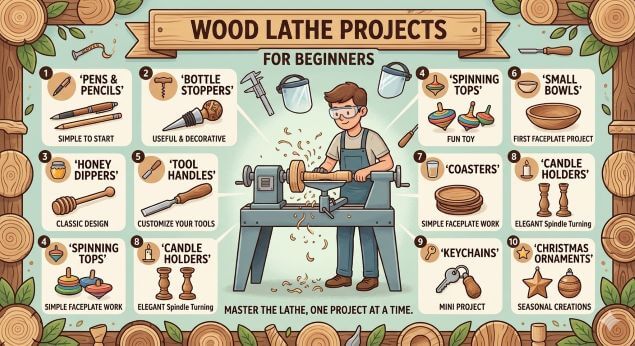
The best way to learn woodturning is to actually turn. For a beginner, the goal isn’t to create a complex masterpiece, but to understand how different tools interact with wood. These 15+ projects are selected because they require minimal materials, offer “quick wins,” and teach fundamental spindle and faceplate skills.
Before starting, ensure you’ve checked our 10 Mandatory Wood Lathe Safety Rules.
The “Quick Win” Projects (Under 1 Hour)
Project 1: The Classic Wooden Pen
- Description: Pen turning is arguably the most popular entry point into the hobby. It requires a specialized mandrel but uses very little wood. This project teaches you how to manage high speeds and apply a durable friction finish. Because the work is small, you learn to be extremely precise with your cuts. It’s the perfect gift and a great way to practice using different wood species without a huge investment.
- Skills Learned: Using a pen mandrel, hardware assembly, and CA glue finishing.
Project 2: Honey Dippers
- Description: A honey dipper is a classic spindle project that looks impressive but is fundamentally simple. It consists of a handle and a head with several deep, parallel grooves. These grooves are perfect for practicing “V-cuts” with a detail gouge. You’ll learn how to keep your spacing consistent and your depths uniform. It’s a functional kitchen tool that allows you to master the “bead and cove” technique which is essential for all future spindle work.
- Skills Learned: Consistent V-cuts, spindle symmetry, and food-safe finishing.
Project 3: Bottle Stoppers
- Description: If you have small offcuts of beautiful hardwood lying around, don’t throw them away—turn them into bottle stoppers. This project involves turning a decorative top and attaching it to a metal or silicone stopper base. It’s an excellent exercise in “free-form” turning, as you can create any shape you imagine. It also teaches you how to drill into the end grain and mount hardware securely, which is a transferable skill for many other projects.
- Skills Learned: Small-scale free-form turning and hardware mounting.
Project 4: Simple Spinning Tops
- Description: Spinning tops are delightful, fast projects that are perfect for practicing the parting tool and the skew chisel. The challenge lies in creating a perfectly centered point so the top spins smoothly without wobbling. You can experiment with different “flywheel” shapes to see how they affect the spin time. It’s a low-pressure project that is great for demonstrating your new hobby to kids or friends.
- Skills Learned: Precision centering and parting tool techniques.
Project 5: Light Pulls or Keychains
- Description: These are miniature spindle projects that focus on delicate detail. Since they are so small, you have to learn how to manage light tool pressure to avoid snapping the thin wood. Turning a light pull is a great way to practice making small beads and coves. You can use colorful wood blanks or even acrylics to make them stand out. It’s an easy way to add a custom touch to your home decor.
- Skills Learned: Delicate bead work and small-scale sanding.
Practical Home & Garden Projects
Project 6: Garden Tool Handles
- Description: Many store-bought garden tools come with cheap plastic or flimsy wood handles that eventually break. Turning your own replacement handles out of a sturdy wood like Ash or Oak is satisfying and practical. This project teaches you how to turn a long, ergonomic cylinder that fits comfortably in the hand. You will also learn how to fit a metal ferrule to the end to prevent the wood from splitting under pressure.
- Skills Learned: Long spindle turning and ergonomic shaping.
Project 7: French Rolling Pins
- Description: Unlike traditional rolling pins with handles and bearings, a French rolling pin is a solid piece of wood that tapers gently toward the ends. This is an elite project for practicing long, smooth tapers without any bumps or dips. You will learn to use a long steady cut with a spindle roughing gouge and finish with a smooth skew chisel pass. It’s a high-value kitchen item that every baker appreciates.
- Skills Learned: Tapered spindle turning and long-grain sanding.
Project 8: Kitchen Mallets
- Description: A wooden mallet is an essential tool for any workshop or kitchen. This project is unique because it involves turning a larger diameter “head” and a thinner “handle” from a single piece of wood (or two pieces joined). It teaches you about wood density and how to create a strong “shoulder” transition. It’s a great project for learning how to handle larger, heavier blanks that might cause more vibration on a budget lathe.
- Skills Learned: Large-scale roughing and transition shoulders.
Project 9: Meat Tenderizer
- Description: Similar to a mallet but with more intricate face work. This project allows you to practice creating a “grid” or textured surface on the end grain. You will learn how to balance a tool that has a heavier head and a thinner handle, ensuring the transition is structurally sound. It’s a great functional piece for your kitchen that showcases both your turning and your hand-tool detailing skills.
- Skills Learned: Weight balancing and end-grain texturing.
Project 10: Ring Holders
- Description: A ring holder is essentially a simple, elegant cone mounted on a small base. This is a fantastic project for practicing a consistent, straight taper on a small scale. You can experiment with different heights and base designs. It’s a very popular gift item and a great way to use up exotic wood scraps that have a beautiful grain pattern. The simplicity of the shape makes any mistake very obvious, which helps you refine your technique.
- Skills Learned: Straight tapering and base-to-spindle transitions.
Decorative & Gift Projects
Project 11: Bud Vases
- Description: A bud vase is a beautiful decorative piece that introduces you to the concept of hollowing. Since it’s meant for dried flowers, you only need to drill a small hole down the center or hollow out a small cavity. This project teaches you how to manage “end grain hollowing,” which can be tricky for beginners. You’ll learn how to keep the exterior walls consistent with the interior hole to prevent the wood from cracking.
- Skills Learned: End grain hollowing and interior/exterior wall alignment.
Project 12: Christmas Ornaments
- Description: Christmas ornaments are the bread and butter of many hobbyist turners. They range from simple snowmen (three spheres) to complex “icicles” with long, delicate finials. This project is the ultimate playground for practicing beads, coves, and thin tapers. It encourages creativity and helps you master the “feel” of your tools on small, light workpieces. Plus, they make incredible heirlooms for family and friends.
- Skills Learned: Fine finial work and multi-part assembly.
Project 13: Magic Wands
- Description: Whether for a fan of fantasy or just for fun, magic wands are great for practicing long, thin spindle turning. The challenge is turning a 10-14 inch piece of wood down to a very thin diameter without it vibrating or breaking. You will learn how to use a “steady rest” or simply your hand to support the wood as it spins. It’s a high-energy project that allows for lots of creative handle designs.
- Skills Learned: Long, thin spindle support and imaginative detailing.
Project 14: Egg Cups
- Description: An egg cup is a small, functional vessel that introduces you to “concave” hollowing. You have to turn a small bowl-like shape on top of a pedestal. This project teaches you how to use a bowl gouge or a scraper on a small scale. It’s a perfect bridge between spindle turning and full-sized bowl turning. Achieving a smooth, rounded interior that fits an egg perfectly is a very satisfying challenge.
- Skills Learned: Small-scale concave hollowing and pedestal shaping.
Project 15: Decorative Mushrooms
- Description: These are whimsical projects that involve turning two separate pieces—the cap and the stem—and joining them together. This teaches you about “friction fits” or using tenons to connect parts. You can get very creative with the cap shapes (flat, domed, or wavy). It’s a low-stress project that looks great in a garden or as a shelf decoration, and it helps you practice matching different components.
- Skills Learned: Multi-part joinery and organic shaping.
Project 16: Ring Bowls
- Description: A ring bowl is your first real step into “faceplate” or “chuck” turning. It’s essentially a very small bowl, making it much less intimidating than a large salad bowl. You will learn how to mount a blank, rough it out, and hollow the interior. It’s the perfect project to practice “riding the bevel” with your bowl gouge. Once you can make a clean ring bowl, you’re ready for the big leagues.
- Skills Learned: Initial faceplate mounting and interior hollowing.
- Internal Link: Ready to go bigger? Read our Beginner’s Guide to Bowl Turning.
Tips for Beginner Success
- Wood Choice: Stick to hardwoods like Maple, Cherry, or Oak. Avoid softwoods like Pine for your first projects as they “tear out” easily and leave a fuzzy surface.
- Batch Turning: If you are making pens or honey dippers, make 5 at a time. Repetition is the only way muscle memory is built in woodturning.
- Tool Sharpness: If the wood looks “hairy” or dusty after a cut instead of producing clean shavings, your tool is dull. Stop immediately and sharpen.
- Sanding is Key: Sanding is 50% of the final quality. Don’t skip grits; start at 80 for shaping and move sequentially to 400 for a glass-like finish.
Conclusion
The lathe is one of the few tools in the shop where you can start with a raw log and have a finished, polished product in less than an hour. Start with the “Quick Wins” to build your confidence, then move on to functional items like rolling pins and tool handles.
What will you turn first? Tag us in your creations and stay safe!