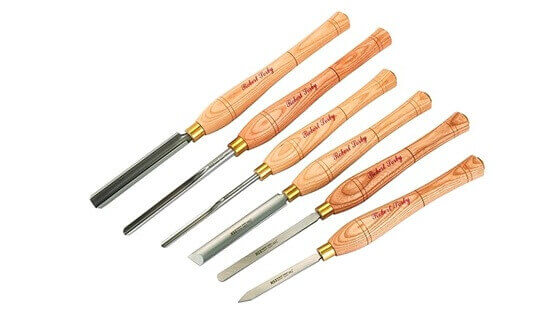
The wood lathe is often called the “King of the Workshop” because it is the only machine capable of taking a raw piece of timber and turning it into a finished, polished product. Whether you are looking to create functional kitchenware, elegant furniture, or intricate art pieces, the possibilities are endless.
This comprehensive list of 50 woodworking projects with a lathe is designed to inspire your next session in the shop. We have categorized these by utility and style to help you find the perfect project for your skill level.
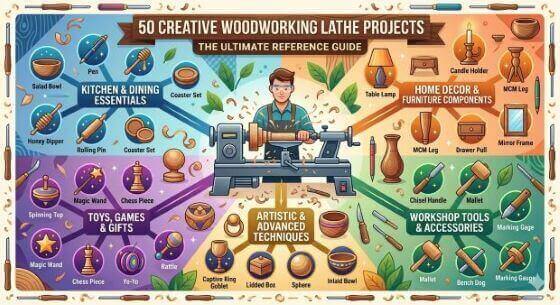
Part 1: Kitchen & Dining Essentials
1. The Classic Salad Bowl
Turning a large salad bowl is a fundamental rite of passage for every woodturner. This project goes far beyond just making a container; it teaches you how to manage large, often heavy, blanks and how to achieve a consistent wall thickness from the rim to the base. You will learn to handle “end grain” and “side grain” transitions, which is crucial for preventing tear-out. A well-turned bowl made from a single piece of Cherry, Walnut, or figured Maple is not just a kitchen utensil but a functional piece of art that can last for generations. The key challenge lies in the hollowing process—maintaining a steady hand to avoid “chatter” while ensuring the interior curve perfectly mirrors the exterior for a balanced feel.
2. Segmented Fruit Platters
Unlike standard bowls turned from a single block, segmented platters involve the complex process of cutting, gluing, and clamping multiple pieces of contrasting wood together before they ever touch the lathe. This project is a favorite for those who enjoy the mathematical side of woodworking, as it requires precise segment angles to ensure a perfect circle. It is an incredible way to utilize expensive exotic wood scraps that would otherwise be wasted. When turned, these segments create stunning geometric patterns that look like fine inlay work. The technical challenge here is the fragility of the glue joints; you must use light cuts and sharp tools to ensure the segments don’t fly apart under centrifugal force.
Tutorial: Youtube video
3. French Rolling Pins
A French rolling pin is an elegant, handle-less tool highly prized by professional bakers for the tactile feedback it provides. Unlike a standard American rolling pin, the French version features a gentle, continuous taper from the thick center to the slender ends. This project is a masterclass in long-spindle symmetry. You must use a spindle roughing gouge for the bulk removal and a skew chisel for that glass-smooth finish. The difficulty lies in ensuring the taper is identical on both sides without any flat spots or “humps.” It’s an excellent project for practicing long, sweeping cuts where your body movement is just as important as your hand placement.
Tutorial: project #7 on the post Wood lathe projects for beginners
4. Salt and Pepper Grinders
Turning a salt or pepper mill is a high-value project that combines fine woodworking with mechanical assembly. It requires deep internal boring, which means you’ll need to master the use of Forstner bits and long-reach hollowing tools. The project is divided into two parts: the body and the top cap, which must align perfectly in both grain and diameter. Beyond the turning, you will learn how to install the grinding mechanism, which requires high precision—if your internal hole is off by even a millimeter, the grinder may bind or wobble. These mills are incredibly popular as high-end gifts and offer a great opportunity to showcase highly figured woods like Birdseye Maple or Olivewood.
5. Honey Dippers
The honey dipper is a deceptive project; it looks simple, but creating perfectly uniform, deep parallel grooves requires a high level of tool control. These grooves serve a functional purpose—the surface tension of the honey holds it in the slots until you’re ready to drizzle. This project is the perfect playground for practicing “V-cuts” with a detail gouge or a diamond parting tool. You will learn how to maintain consistent spacing and depth across a small diameter. Since these tools come into direct contact with food, it’s also a great chance to experiment with food-safe “friction finishes” like beeswax and mineral oil, which are applied while the piece is still spinning on the lathe.
Tutorial: project #2 on this post
6. Wooden Goblets
Turning a wooden goblet is an exercise in finesse and vibration management. The most impressive goblets feature a thin, delicate stem that tests the limits of the wood’s strength. As you hollow out the “cup” portion, the wood becomes thinner and more prone to vibrating or “singing,” which can lead to catastrophic failure if not handled correctly. This project teaches you the importance of “supporting the cut” with your fingers (safely!) and using very light, sharp passes. Many turners even add “captive rings” to the stem—rings that are turned from the same piece of wood but move freely—adding a “wow” factor that demonstrates extreme technical skill.
Tutorial: Youtube video
7. Mortar and Pestle
The mortar and pestle project is all about durability and ergonomics. The mortar requires a heavy, stable base and a smooth, concave interior that can withstand the constant friction of grinding spices. The pestle must be turned to fit comfortably in the palm of the hand, with a rounded end that matches the interior curve of the mortar perfectly. This project involves both faceplate work (for the mortar) and spindle work (for the pestle). You’ll need to use dense, closed-grain hardwoods like Hard Maple or Beech to ensure that food particles don’t get trapped in the pores. It’s a rewarding project that produces a tool that is as beautiful on the counter as it is useful in the kitchen.
Tutorial: this video
8. Napkin Rings
Napkin rings are the ultimate production project. Because they are usually made in sets of four, six, or eight, they force you to develop consistency in your shapes and dimensions. You will practice “batch turning,” where you learn to replicate a design exactly by using calipers and story sticks. This project involves hollowing out a cylinder and then shaping the exterior. It’s a fantastic way to experiment with different textures—you can leave them smooth, add decorative beads, or use a “chattering tool” to create intricate patterns. They are quick to make, use very little wood, and are perfect for selling at craft fairs or giving as personalized housewarming gifts.
Tutorial: this video
9. Citrus Reamers
A wooden citrus reamer is a specialized tool that requires a unique geometric approach. The head of the reamer must have sharp, deep ridges to effectively extract juice from lemons or limes. Turning these ridges involves using a small detail gouge or a triangular file while the lathe is spinning slowly or using an indexing system. The handle needs to be ergonomically designed for a firm grip during heavy squeezing. This project is a great lesson in combining form and function, and it makes for an interesting display item in a home bar.
Tutorial: this video
10. Coaster Sets with Holder
While individual coasters are simple faceplate projects, creating a complete set with a matching holder elevates the craftsmanship. Each coaster must be turned with uniform thickness and diameter, requiring careful use of calipers. The holder is the real challenge; it must be turned so that the inside diameter is only a fraction of a millimeter larger than the coasters to ensure a “piston fit.” This project teaches you about wood expansion and engineering tolerances.
Tutorial: this video
Part 2: Home Decor & Furniture Components
11. Mid-Century Modern Furniture Legs
Tapered furniture legs are icons of Mid-Century Modern design. Turning a set of four identical legs is a rigorous test of your ability to replicate angles and diameters. You will learn to use “story sticks” to mark critical transition points and calipers to ensure every leg is uniform. Any minor deviation will make the furniture wobbly. This is a high-impact project that allows you to build your own high-quality furniture at a fraction of the cost.
Tutorial: this video
12. Custom Drawer Pulls
Why settle for mass-produced metal hardware when you can turn your own wooden drawer knobs? This is a fantastic “micro-project” that allows you to add a personal touch to cabinets or dressers. The challenge here is the scale; you are working with small pieces of wood, often high-end exotics or burls. You will learn how to turn small beads and how to drill pilot holes for standard screws. Since you need multiple knobs for one piece of furniture, you will naturally improve your consistency.
13. Table Lamps
Turning a table lamp is one of the most exciting decor projects because it introduces the “long-hole boring” challenge. You must drill a hole through the entire length of the lamp base to run the electrical cord. This requires a specialized lamp auger and a steady hand to ensure the bit doesn’t drift out the side of the wood. Once bored, you can be infinitely creative with the exterior shape. This project teaches you about structural integrity and integrating non-wood components into your turnings.
14. Candlestick Holders
Candlestick holders are a classic spindle project offering endless design possibilities. The project focuses on creating a series of “beads and coves”—the basic building blocks of all spindle turning. You will learn how to use a detail gouge to create sharp transitions between shapes. A critical safety and functional aspect is drilling the candle socket: it must be perfectly centered and sized to hold the candle securely. This is a great project for utilizing long, thin offcuts.
Tutorial: this video
15. Wall Clocks
Turning a wall clock involves working with a large diameter wooden disk, a great way to practice faceplate turning. The goal is to create a flat, stable surface that showcases the natural beauty of the wood grain. You will learn how to sand a large flat surface without creating “dishing” or ridges. Once the disk is turned, you simply drill a center hole for the clock movement. You can further customize it with pyrography or by inlaying contrasting wood markers.
Tutorial: this video
16. Finials for Curtain Rods
Finials are the “jewelry” of interior design. Practice your small-scale detail turning by creating matching end-pieces for your curtain rods or bedposts. This project requires finesse as you work at a small scale where one heavy cut can ruin the entire profile. You will learn how to create tenons to fit into the rod securely. This is a perfect way to bring a high-end, custom look to your home using scrap wood.
Tutorial: this video
17. Mirror Frames
Turning a large mirror frame requires a lathe with significant swing capacity or outboard turning capability. This is a beautiful way to display a custom mirror in an entryway. You will learn how to turn “rabbets” on the back of the frame to seat the mirror glass snugly. The biggest challenge is ensuring the frame doesn’t warp over time, so choosing well-seasoned wood is vital. The finished product is a high-end furniture piece that draws every eye.
Tutorial: this video
18. Bud Vases (Dry Only)
Bud vases are small hollow forms. Since they aren’t meant to hold water (unless using a plastic insert), you can focus entirely on the exterior shape and internal hollowing technique. This project teaches you how to manage “end grain” hollowing, a skill that will help you when moving to larger vessels. You will learn to maintain uniform wall thickness even when you cannot see inside. The result is an elegant decorative piece, perfect for wood with dramatic grain patterns.
19. Floating Shelves with Turned Supports
Combine flat woodworking with woodturning by creating decorative shelves that rest on artfully turned wooden spindles. This provides a sophisticated, classic look for any wall. You will need to turn at least two identical supports in both shape and height to ensure the shelf is level. This project teaches you how to join turned parts to flat surfaces using round tenons. It is a great way to upgrade home storage into a handcrafted design statement.
Tutorial: this video
20. Ring Holders
A tapered wooden cone on a stable base is the perfect way to organize jewelry. This is a 15-minute project that makes an excellent gift. You will practice creating a consistent taper from the base to the tip. The challenge here is turning the tip very small and sharp without it breaking under tool pressure. Using dense woods like Ebony or Rosewood will make the piece feel incredibly luxurious and durable.
Tutorial: this article
Part 3: Workshop Tools & Accessories
21. Custom Chisel Handles
Most factory chisel handles are generic. Turning your own allows you to customize the size to fit your hand perfectly, using hardwoods like Ash to ensure durability and impact resistance. You will learn how to install a metal ferrule at the tip to prevent the wood from splitting when struck with a mallet. This project not only improves your toolkit but also helps you practice ergonomic shaping to reduce hand fatigue during long work sessions.
Tutorial: this video
22. Wooden Mallets
A sturdy wooden mallet is indispensable for assembly work. This project teaches you about weight distribution and how to create a friction-fit for the handle. The mallet head is usually turned from a very heavy, dense block like Oak or Osage Orange. You will learn to balance aesthetics with practical function, ensuring the striking surface is flat and wide enough. This is a great “break-in” project that leaves you with a tool that will stay with you for decades.
Tutorial: this video
23. File and Screwdriver Handles
Scraps of dense hardwood are perfect for turning ergonomic handles for metal files or custom driver bits. Instead of using cheap plastic handles, a natural wood handle provides better grip and absorbs hand sweat effectively. You will practice precise center-hole drilling to insert the file tang. This is a quick project that helps clean up your shop’s scrap pile while making your hand tools look significantly more professional.
Tutorial: this video
24. Marking Gauges
A homemade marking gauge involves spindle turning and creating a sliding mechanism. This is a precision measuring tool that every woodworker finds useful. You will learn how to turn a perfectly round sliding bar that moves smoothly within the gauge body. The biggest challenge is ensuring a tight yet adjustable fit between the components. Creating your own measuring tools brings great pride and a deeper understanding of accuracy in woodworking.
Tutorial: this video
25. Lathe Tool Racks
Use the lathe to make parts for the lathe itself! Turned wooden pegs are the perfect components for building a custom tool rack to keep your gouges and chisels organized. You will learn how to batch-turn pegs of uniform size. This rack helps protect the cutting edges of your tools from banging into each other while keeping your workshop clean and efficient.
Tutorial: this video
26. Plumb Bobs
A plumb bob is a classic tool for ensuring verticality. Turning a perfectly balanced weight with a sharp, pointed end is a great exercise in precision. You will learn how to work with high-density woods and how to attach a string to the center to ensure it always hangs straight. This project requires meticulous attention to sharpening the tip to achieve the highest accuracy in construction and joinery.
Tutorial: this video
27. Bench Dogs
Custom bench dogs can be turned to exact specifications, ensuring a perfect fit for the holes in your workbench. You will learn how to create a head shape that holds workpieces securely without marring the wood surface. Using hardwoods like White Oak will help these pegs withstand significant pressure from workbench clamps. This is a practical, low-cost project that provides immense benefits for future flat-woodworking projects.
Tutorial: this video
28. Sanding Blocks (Turned Grips)
Creating specialized sanding bars with turned grips makes sanding curved surfaces much more comfortable. You will design the handle to fit the palm of your hand, minimizing joint fatigue during long sanding sessions. This project allows you to be creative with different ergonomic shapes. A good set of sanding grips will make the most “dreaded” phase of woodworking more pleasant and efficient.
29. Marking Mallets (Small)
Unlike heavy assembly mallets, marking mallets are small and lightweight, used for delicate tapping on chisels during joinery. Turning these requires a focus on balance and a very smooth finish. You will learn to create a head that is precisely weighted to give you “feedback” through the tool. These are often made from beautiful scraps of exotic wood and are a pleasure to use for fine dovetail work.
Tutorial: this video
30. Center Finders
A small turned cone or cylinder can be modified into a center-finder tool for your shop, helping you prepare wood blanks for future lathe projects quickly. You will learn how to turn a perfect 60-degree cone, corresponding to the angle of lathe centers. This is a simple but incredibly useful tool that saves measuring time and ensures your blanks are always mounted in the optimal position to reduce vibration.
Part 4: Toys, Games & Gifts
31. Spinning Tops
Quick, fun, and addictive. Turning a top that can spin for minutes is a test of balance and point precision. You will learn to manage weight distribution so the “flywheel” part is heavier to create momentum, while the tip must be extremely smooth and hard. This is a great gift project and a good way to practice using a parting tool and skew chisel with mastery.
32. Custom Chess Sets
This is a massive project involving the turning of 32 chess pieces. It requires incredible consistency to ensure kings, queens, and pawns match each other in height and style. You will learn to use templates to replicate the exact profile for every piece. Completing a handcrafted chess set from two contrasting woods (like Maple and Walnut) is the ultimate proof of a woodturner’s patience and skill.
33. Magic Wands
Popular with children and fantasy fans, wands are a playground for detail turning. You can experiment with complex spirals and intricate finials. The biggest challenge is turning a long, very thin rod without it vibrating or snapping. You will learn how to use your left hand to support the workpiece (back-rest) while the lathe is spinning. Each wand is unique, allowing your creativity to run wild.
34. Wooden Yo-Yos
A yo-yo requires two identical halves and a precisely centered axle. This is an excellent introduction to small-scale faceplate turning and weight balancing. You will learn how to join the two halves so they don’t wobble when spinning at high speeds. This project brings great joy upon completion, as you can actually play with what you made. Using figured wood turns this simple toy into a prized collectible.
35. Baby Rattles
Captive rings—rings that move freely but cannot be removed—are the “wow” feature on classic wooden rattles. This project requires specialized tools to cut the ring free from the block while it’s being turned. Note: Only use non-toxic woods and food-safe finishes like beeswax, as babies often put toys in their mouths. This is a deeply meaningful gift for new parents, carrying tradition and craftsmanship.
36. Kaleidoscope Bodies
Turn a stunning exterior shell for a kaleidoscope kit. This project combines woodturning with optical components to create an impressive gift. You will learn how to hollow out the inside of a long wooden tube to fit the mirror system perfectly. The challenge is maintaining a thin wall thickness that is still strong enough not to crack. A kaleidoscope made from precious wood is a sophisticated decor item for a desk or shelf.
37. Wooden Eggs
Turning a perfect, symmetrical egg is surprisingly difficult. it requires constant checking of curves and is a great way to use burl wood scraps. You will learn how to turn between centers and then finish the ends using a “jam chuck.” A basket of wooden eggs featuring different wood species creates a unique rustic home decor collection.
38. Whistles
Wooden whistles are simple to make and can be tuned by changing the length of the internal cavity. You will learn how to cut the “fipple” (air slot) precisely to create a clear sound. This project combines woodturning with basic acoustics. They are great small gifts for outdoor activities and help you practice drilling precise blind holes.
39. Baseball Bats
Turning a baseball bat is a classic spindle project that requires a long bed lathe. You will learn how to manage a very long workpiece and the importance of grain orientation for strength. The project involves creating a long, smooth taper from the barrel to the handle. It’s a great way to learn about the properties of woods like Ash and Maple, which are traditionally used for their impact resistance.
40. Toy Wheels
If you build toy cars or trucks, the lathe is the best tool for producing identical, perfectly round wheels with centered axles. You can turn grooves for tires or create artistic shapes for wooden wheels. This project helps you practice batch faceplate turning and ensures absolute size synchronization. This is a foundational skill for any wooden toy maker who wants their products to move smoothly.
Part 5: Artistic & Advanced Techniques
41. Hollow Forms with Bark Edges
Using a piece of “live edge” wood, you can turn a hollow vessel that keeps the natural bark at the rim. This creates a rugged and striking appearance. The biggest challenge is turning at high speeds while bark fragments might fly off, requiring CA glue to stabilize the bark before turning. This project teaches you to appreciate natural wood features and turn “defects” into high-value artistic accents.
42. Multi-Axis Turning
By changing the center points of the wood during turning, you can create non-cylindrical shapes like oval bowls or abstract sculptures. This is an advanced technique requiring careful geometric calculation and excellent vibration control. You will learn to work with the “ghost image”—the blurred vision of the off-center wood as it spins. The results are modern art pieces that break the rules of traditional lathe symmetry.
43. Lidded Boxes with Suction Fit
A lidded box that fits so tightly it makes a “pop” sound when opened is the gold standard for box turners. It requires extremely high-precision measurements and an understanding of wood movement. You will learn to turn the body and lid separately while ensuring they mate perfectly at the joint. This is the best test of caliper skills and patience. A small wooden box is a great place to store jewelry or keepsakes.
44. Calabash Bowls
A deep, rounded bowl inspired by traditional Hawaiian designs. This project focuses on achieving a continuous, smooth internal curve without any “flat spots.” You will learn to use a bowl gouge with a “riding the bevel” technique in deep, narrow spaces. The Calabash shape requires the wall to thin toward the rim, creating a light and airy feel for a heavy wood piece.
45. Turned Spheres
Turning a perfect sphere without a specialized jig is a high-level skill. it involves rotating the wood on multiple axes to remove high spots and achieve absolute roundness. You will learn to use PVC pipe sections or circular templates to check the curve. Turning a smooth sphere from a burl block is a testament to a turner’s spatial awareness and hand-eye coordination.
46. Captive Ring Wine Goblets
Elevate the goblet project by adding a free-spinning ring on the stem, turned from the same piece of wood. This is a true performance technique requiring specialized hollowing tools and deep concentration. The ring symbolizes connection and the maker’s virtuosity. These pieces are often used as showstoppers in craft exhibitions, demonstrating a deep understanding of wood structure and cutting technique.
47. Off-Center Pendants
Use small scrap pieces and turn them off-center to create unique modern jewelry. By shifting the center point only a few millimeters, you can create interesting bevels and shapes without a carving machine. This project teaches you to utilize the lathe’s high speed to create ultra-smooth surfaces on a micro scale. These wooden pendants, when combined with resin or metal inlays, become high-end fashion accessories.
48. Wooden Bangles
Turning jewelry like bracelets requires a chuck to hold the wood from the inside while you shape the outside. This is a great way to use racy-grained exotic hardwoods. You will learn how to hollow the bangle interior to fit the wearer’s wrist comfortably and sand it to a mirror-like finish. A well-finished wooden bangle offers a natural, warm beauty that is incredibly fashionable.
49. Inlaid Bowls
Turn a bowl, then carve or turn a groove to inlay contrasting woods, metal powders, or crushed stone (like turquoise) to create a high-end artistic look. This project combines woodturning with surface decoration skills. You will learn how to use CA glue to set the inlay material and then turn the surface flush again. Inlay techniques help hide natural cracks or simply add a layer of luxury to the work.
50. Natural Edge Platters
Like live-edge hollow forms, this platter keeps the natural bark around the wide rim, showcasing the transition from raw log to refined object. It’s a balance challenge, as the platter will be very unbalanced initially. You will learn to position the blank so the bark edge runs parallel to the platter’s face. The result is a high-class centerpiece that celebrates the original beauty of nature.
Conclusion: Why the Lathe is Essential
The variety of projects possible with a wood lathe is unmatched. From the smallest keychain to the legs of a dining table, the lathe allows you to bring precision and beauty to every corner of your woodworking.
Which of these 50 projects will you tackle next? Let us know in the comments and don’t forget to visit our Safety Guide before you start.